


 https://www.hepanet.de/wp-content/uploads/2018/02/5d3abfd6-091e-4718-8a90-86af2c4ab8b2.png
1024
1536
Uwe Jost
https://www.hepanet.de/wp-content/uploads/2025/11/Logo-HepaNet-RGBtransparentneu-groesser-HSK39CMYK90-50-0-0-1030x163.png
Uwe Jost2026-02-11 13:56:062026-02-12 18:44:18CLEANOS now MDR certified
https://www.hepanet.de/wp-content/uploads/2018/02/5d3abfd6-091e-4718-8a90-86af2c4ab8b2.png
1024
1536
Uwe Jost
https://www.hepanet.de/wp-content/uploads/2025/11/Logo-HepaNet-RGBtransparentneu-groesser-HSK39CMYK90-50-0-0-1030x163.png
Uwe Jost2026-02-11 13:56:062026-02-12 18:44:18CLEANOS now MDR certifiedTelefonic consultancy
If you have any questions about the topics presented here, we will be pleased to advise you personally. Call us now!
The OPAL procedure
How does the principle work? Learn more about the exact mechanics of albumin dialysis.
Experience through research
Our team consists of experienced staff, each of whom are proven experts in their field.

Information about the topic
Liver dialysis
Under the heading Liver dialysis, you will find information on the subject of blood washing using albumin dialysis with the new OPAL system:
The following topics are addressed:
- OPAL system: circuits and setup
- Indication: When to use?
- Implementation: What do you need for the OPAL procedure?
- Reimbursement: How to do documentation and billing
- Specialist literature on the subject of liver
Join Organ Support Therapy
HepaNet Launches Innovation in Its 20th Anniversary Year
HepaNet is delighted to celebrate its twentieth anniversary in 2026 by introducing a significant new product: the Cleanos®.
The Cleanos® is a state-of-the-art liver dialysis device that, for the first time, offers a Solo Mode – enabling pure liver dialysis without the need for simultaneous kidney dialysis. Naturally, the proven Combi Mode, which allows for combined liver and kidney dialysis, remains an integral feature.
The device is notably smaller, more compact, and exceptionally quick to set up, designed for maximum efficiency and user-friendliness. Together with the new OPAL systems, the Cleanos® represents an important step forward in expanding treatment options and enhancing the well-being of patients.
HepaNet looks forward to setting a new standard in liver dialysis technology with the Cleanos®.
You can find more information HERE or contact us. We look forward to hearing from you!
20 years of research
in the field of albumin dialysis
only 400ml HA20%
necessary for build-up
15 years of application experience
in the field of albumin dialysis
10 years experience
in the reimbursement
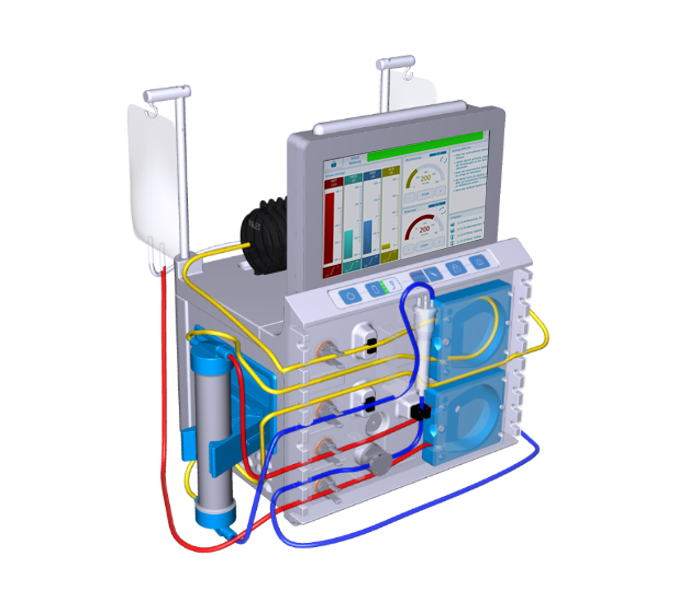
Albumin dialysis was developed in the early 1990s.
Albumin dialysis
Two nephrologists from the University Hospital Rostock, Prof. Steffen Mitzner and Prof. Jan Stange, developed a procedure that had overcome the previous problems in the detoxification of the blood. Behind it is actually a simple solution. Whereas in the past the blood with its toxins was led directly over the adsorber surfaces (haemoperfusion) and thus besides immense coagulation problems (complement activation, fibrinogen adsorption) also allergic reactions were observed, the previous procedure was also very unselective.
What could be more natural than to free the blood from the toxins with a “natural” trick? This was achieved using a special membrane that allowed molecules below 50,000 daltons to pass through. On the dialysate side, these toxins are then taken up by clean, bindable human albumin and fed to a purification process in adsorbers. This method was implemented by means of a combination of a liver dialysis module with a supplementary kidney dialysis machine. Various combinations with the most common HD and CRRT devices were used. After years of use and some studies, many users felt that further development was needed. In particular, the clearance should be optimized and the structure handling simplified. These requirements were currently implemented in the OPAL process.
Clinics
According to the needs of your clinic, HepaNet can help in addition.
Practice
Here you can find out what equipment is required in the outpatient area.
Literature
Here you will find further literature and book tips from HepaNet.
 https://www.hepanet.de/wp-content/uploads/2018/02/5d3abfd6-091e-4718-8a90-86af2c4ab8b2.png
1024
1536
Uwe Jost
https://www.hepanet.de/wp-content/uploads/2025/11/Logo-HepaNet-RGBtransparentneu-groesser-HSK39CMYK90-50-0-0-1030x163.png
Uwe Jost2026-02-11 13:56:062026-02-12 18:44:18CLEANOS now MDR certified
https://www.hepanet.de/wp-content/uploads/2018/02/5d3abfd6-091e-4718-8a90-86af2c4ab8b2.png
1024
1536
Uwe Jost
https://www.hepanet.de/wp-content/uploads/2025/11/Logo-HepaNet-RGBtransparentneu-groesser-HSK39CMYK90-50-0-0-1030x163.png
Uwe Jost2026-02-11 13:56:062026-02-12 18:44:18CLEANOS now MDR certified https://www.hepanet.de/wp-content/uploads/2016/02/medical-team-1.jpg
720
1500
casusbene
https://www.hepanet.de/wp-content/uploads/2025/11/Logo-HepaNet-RGBtransparentneu-groesser-HSK39CMYK90-50-0-0-1030x163.png
casusbene2021-08-14 18:00:422024-07-09 14:02:3015 years of HepaNet
https://www.hepanet.de/wp-content/uploads/2016/02/medical-team-1.jpg
720
1500
casusbene
https://www.hepanet.de/wp-content/uploads/2025/11/Logo-HepaNet-RGBtransparentneu-groesser-HSK39CMYK90-50-0-0-1030x163.png
casusbene2021-08-14 18:00:422024-07-09 14:02:3015 years of HepaNet https://www.hepanet.de/wp-content/uploads/2017/11/DIVI-Logo.jpg
108
358
casusbene
https://www.hepanet.de/wp-content/uploads/2025/11/Logo-HepaNet-RGBtransparentneu-groesser-HSK39CMYK90-50-0-0-1030x163.png
casusbene2017-11-15 18:00:392025-11-26 12:55:32DIVI 2025! Come visit us! We look forward to seeing you!
https://www.hepanet.de/wp-content/uploads/2017/11/DIVI-Logo.jpg
108
358
casusbene
https://www.hepanet.de/wp-content/uploads/2025/11/Logo-HepaNet-RGBtransparentneu-groesser-HSK39CMYK90-50-0-0-1030x163.png
casusbene2017-11-15 18:00:392025-11-26 12:55:32DIVI 2025! Come visit us! We look forward to seeing you! https://www.hepanet.de/wp-content/uploads/2016/07/corporate-buildings-m.jpg
1155
1732
casusbene
https://www.hepanet.de/wp-content/uploads/2025/11/Logo-HepaNet-RGBtransparentneu-groesser-HSK39CMYK90-50-0-0-1030x163.png
casusbene2017-11-15 18:00:372023-05-17 11:50:5125 years of liver dialysis
https://www.hepanet.de/wp-content/uploads/2016/07/corporate-buildings-m.jpg
1155
1732
casusbene
https://www.hepanet.de/wp-content/uploads/2025/11/Logo-HepaNet-RGBtransparentneu-groesser-HSK39CMYK90-50-0-0-1030x163.png
casusbene2017-11-15 18:00:372023-05-17 11:50:5125 years of liver dialysis https://www.hepanet.de/wp-content/uploads/2014/08/HepaMobil1.jpg
412
960
casusbene
https://www.hepanet.de/wp-content/uploads/2025/11/Logo-HepaNet-RGBtransparentneu-groesser-HSK39CMYK90-50-0-0-1030x163.png
casusbene2017-11-15 18:00:152020-03-11 10:48:46Congresses
https://www.hepanet.de/wp-content/uploads/2014/08/HepaMobil1.jpg
412
960
casusbene
https://www.hepanet.de/wp-content/uploads/2025/11/Logo-HepaNet-RGBtransparentneu-groesser-HSK39CMYK90-50-0-0-1030x163.png
casusbene2017-11-15 18:00:152020-03-11 10:48:46Congresses